THE LEGAL STATUS OF A DOG
THE LEGAL STATUS OF A DOG
Under Australian law a dog is classified as a 'chattel' i.e. movable property, and hence a dog can be legally owned and can be legally stolen.
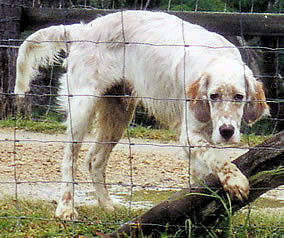
I am the legal owner of Beau and this will never change because I have not willingly nor legally sold Beau nor passed legal ownership of Beau over to someone else, including any organisation involved in the handling, treatment and re-homing of dogs.
The stealing of a dog is a crime.
CRIMES ACT 1900 SECTION 132 - STEALING DOGS
This legislation states: "Whosoever, having been summarily convicted under this or any former Act, of any such offence as is hereinafter in this section mentioned, afterwards,
steals any dog, or
has unlawfully in his or her possession any stolen dog, knowing such dog to be stolen, shall be liable to imprisonment for one year."
On 2 July 2003 it was the expert opinion of the Police that Beau had been stolen. However even though they considered this highly unlikely the Police recommended I wait to see if Beau was found from my advertising that week before the crime report was completed. On 8 July 2003 the Police completed the crime report and issued me with a Police Crime report number. Beau was then a legally stolen dog under Australian law.
The completion of a Police crime report is very important. Otherwise the case will fall into a civil law dispute rather than criminal law.
Under criminal law, when the location of the stolen dog is determined, the Police can organise a search warrant so that the dog cannot be harmed or moved on, enter the premises and return the stolen dog to his or her legal owner. There is no requirement for the legal owner of the stolen dog to go to court in order for his or her dog to be returned to them. This is not the case with a civil law dispute.
The Police investigate a crime with the aim of finding the offender. The Police do not have the resources to investigate the crime of stealing a dog unless you have a definite suspect and can provide proof that this suspect stole your dog. Even in this case, dog stealing is not a priority for the Police.
This does not mean that a crime has not been committed and the dog has not been stolen.
In addition to the Crimes Act 1900 Section 132, the following legislation is applicable to the State of Queensland:
Reprint No. 7A effective 1 July 2009 of the Criminal Code Act 1899 by the Office of the Queensland Parliamentary Counsel, Schedule 1 The Criminal Code, Part 6 Offences relating to property and contracts, Chapter 36 Stealing.
The information I provide on this web page has been criticised and claimed to be inaccurate by certain members, one in particular, of an internet purebred dog forum. This is nothing other than an attempt to try to discredit me in my ongoing search for Beau even though Beau is a purebred dog. I have provided the information on this web page to help other responsible dog owners who unfortunately find themselves in the same or similar position. Except for this purebred dog forum, I have only received positive feedback. In any event it is always wise to seek professional legal advice which is what I did when Beau was stolen.
Please try not to allow ignorant and vindictive humans to discourage you in your attempts to find your stolen dog and please recognise your legal ownership which DOES NOT CHANGE when your dog is stolen.
Stealing a dog is not only a crime, it is one of the worst forms of animal abuse and cruelty.
THE LEGAL STATUS OF ANIMALS
 There is a considerable amount of information on the internet regarding the legal status of animals. Professor Jerrold Tannenbaum, School of Veterinary Medicine and Adjunct Professor, School of Law, University of California states in 'Animals and the law: property, cruelty, rights - In the Company of Animals':
"This law dates back to 1066 with the victory of William the Conqueror over King Harold. A relatively large number of people possessed what were then called "cattle": oxen, cows, sheep, goats, horses, and chickens. When someone stole one's cattle or claimed the right to possess it, this was a serious matter, and litigation would often ensue. This is why the law came to use the term "chattel" for movable goods over which there were disputes as to rights of possession. The similarity in the words "cattle" and "chattel" is not coincidental. Among the first chattel were cattle.
Animals, and certainly the great majority of animal species with which people come in regular contact, will continue to be classified as property. Otherwise, it would be impossible to buy or sell animals, to pass their ownership on through inheritance ...
The legal status of animals as property is consistent with a more realistic recognition by the law not just of their intrinsic value but of their importance and value to people.
There are many ways the law can treat animals which would reflect more accurately their value and worth to people. Some courts have allowed some recovery for emotional distress caused by the negligent injury or destruction of an animal on the grounds that the true value of these beings can include the sentimental or emotional value to their owners.
There is much more the law can do to improve the treatment of animals. Too many animals are treated inappropriately, in laboratories, on farms, in the animal racing industry, and by pet owners.
However, the legal status of animals as property does not of itself preclude major improvements in the use and treatment of animals."
THE LEGAL STATUS OF A MOTOR VEHICLE
Under Australian law a motor vehicle is also classified as a 'chattel' and hence a motor vehicle can be legally owned and can be legally stolen.
The stealing of a motor vehicle is a crime as is the stealing of a dog. The Police investigate the stealing of motor vehicles and offenders are charged in Court and most serve jail sentences. The Police do not allocate resources to investigate the stealing of dogs even though the value of a dog can be much higher than the value of a motor vehicle.
My dog "Beau" is worth much more to me than my motor vehicle. Each one of my companion animals is worth much more to me than my motor vehicle. I spent much more money caring for Beau and searching for Beau since 1 July 2003 than I spent purchasing my 4WD motor vehicle and maintaining, insuring and registering my motor vehicle over this time.
 MICROCHIPPING A DOG
A microchip is a form of identification only, like an ear tattoo.
A microchip and an ear tattoo make it easier to identify the dog and return the dog to his or her legal owner if the dog goes "missing" and is later found.
A microchip in itself does not determine legal ownership.
Legal ownership is determined by relevant legislation, as described above, and occurs when the dog is legally purchased and changes when the dog is legally sold.
Legally and morally you should be advised if a veterinary practice, council dog pound or RSPCA animal shelter handles your stolen dog because you will always remain the legal owner of your dog. The reality is that you are ignored by the large majority of these organisations.
This is because of the widespread apathy towards stolen dogs (all companion animals) throughout Australia.
On 21 November 2005 Mr Glenn Lynch, Registrar, Board of Veterinary Surgeons of New South Wales advised me in writing that:
"A veterinarian is not obliged by any law to scan animals he is treating even if it is a Police matter."
More than 13 years have passed since Beau was stolen. Legislation has still not been introduced in Australia to ensure that veterinarians do not continue to ignore criminal law and property law. By being allowed to do this, veterinarians are supporting criminal behaviour and cruelty towards animals.
Is it any wonder very few stolen dogs are ever found and reunited with their loving families, who are their legal owners, even when the dog is microchipped or has an ear tattoo !!!
"Laws can embody standards, governments can enforce laws but the final task is not a task for government. It is a task for each and every one of us. Every time we turn our heads the other way when we see the law flouted, when we tolerate what we know to be wrong, when we close our eyes and ears to the corrupt because we are too busy, or too frightened, when we fail to speak up and speak out, we strike a blow against freedom and decency and justice." ~ Robert Francis Kennedy.
